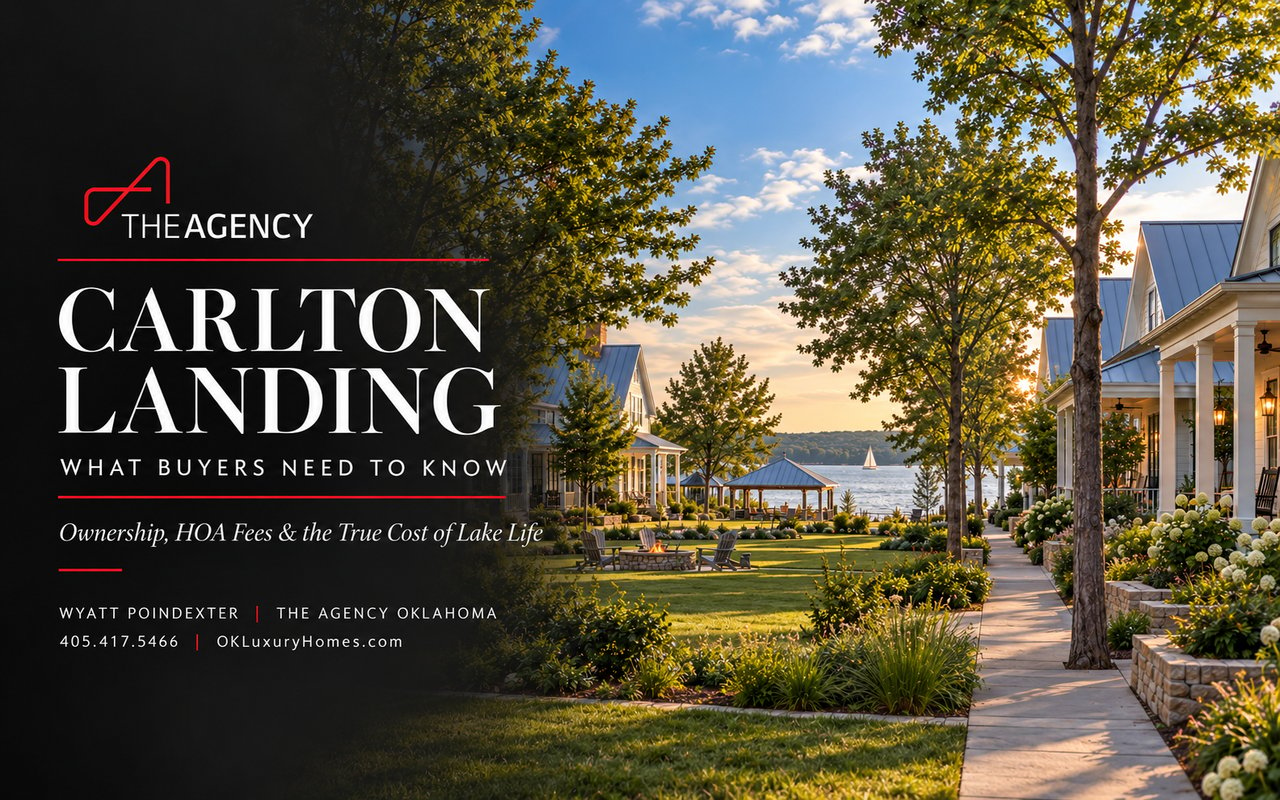
When developer Grant Humphreys was pitching the idea of a New Urbanist town on the shores of Lake Eufaula, he put it simply: "We didn't see anything like this in the state." He was right. There is nothing else in Oklahoma quite like Carlton Landing, with its narrow tree-lined streets, standing-seam metal roofs, and a town plan borrowed from the same firm that designed Seaside and Rosemary Beach in Florida.
But the sentence that should follow that quote, the one the marketing rarely gets to, is that Carlton Landing isn't one real estate market. It's at least three, stacked under a single town name, and a buyer comparing a listing price there to a lake home in Grand Lake or a cabin in Broken Bow is often comparing three different things without realizing it.
Two Listings, Same Town, Different Math
Search for property at Carlton Landing and you may run into a name that doesn't sound like a house for sale at all: The Residence Club at Carlton Landing. It's listed through Elite Alliance, a global exchange network built around fractional real estate, the kind of arrangement where a buyer owns a deeded share of a property and a set window of use each year rather than the whole thing outright.
That's a fundamentally different financial product from a fee-simple single-family home on Firefly Park or Water Street. A fractional share prices out the cost of a slice of a house and a slice of a year. A whole-home purchase prices the entire asset, the entire tax bill, and the entire HOA obligation. If a buyer is mentally averaging "what Carlton Landing costs" from a handful of listings without separating fractional inventory from full ownership, the number they land on won't mean anything. This is the first question worth asking before you get attached to a price: am I looking at a whole house, or a piece of one?
A Town Sized for 5,000, Living Like a Weekend Crowd
The second gap between the pitch and the paperwork shows up in the U.S. Census. As of the 2020 count, Carlton Landing's incorporated town had a population of 94 people across 239 housing units, with 86.6 percent of those units recorded as vacant. That's not a town falling apart. It's a town where the overwhelming majority of homes are second homes, rented out part of the year or sitting empty between visits from owners in Oklahoma City, Tulsa, or North Texas.
The Congress for the New Urbanism, which has documented the project, noted a few years back that the town was roughly one-fifth built toward its eventual plan of more than 5,000 residents by around 2040. Put those two facts together and you get an honest picture: Carlton Landing today is an early phase of a very long build-out, occupied mostly on weekends and holidays, not a finished neighborhood with a stable year-round population.
For a lifestyle or second-home buyer, that's not a red flag. It's simply what the product is, and it should shape expectations. The street outside your porch may be quiet on a Tuesday in February and packed on a Saturday in June. Short-term rental competition from other part-time owners is part of the fabric here, not an exception to it. And construction activity, given the fraction of the master plan that's built, is likely to be part of the landscape for years, not a temporary inconvenience before "the real neighborhood" arrives.
The Fee Depends on the Phase, Not Just the View
Where this gets interesting for anyone running the numbers is in the HOA dues themselves. Active listings this summer showed monthly HOA fees ranging from roughly $200 to $632, and the pattern isn't simply "waterfront costs more."
Lot Type | Approx. Monthly HOA | Notable Detail |
|---|---|---|
Waterfront lot, built 2021 | $200/mo | 0.055-acre lot |
Waterfront lot, built 2022 | $450/mo | 0.115-acre lot |
Interior lot, built 2019 | $256/mo | Standard single-family |
Interior lot, built 2017 | $221/mo | Standard single-family |
Larger estate-style lot, built 2022 | $500/mo | 0.341-acre lot, 8-car garage |
Newest construction, built 2024 | $632/mo | 0.067-acre lot |
That last row is the one worth sitting with. A home finished in 2024 on a modest 0.067-acre lot carries a monthly fee of $632, nearly triple the $221 a month attached to a similarly modest 0.052-acre lot built back in 2017, and well above the $500 a month tied to a much larger estate-style lot from 2022. Lot size doesn't explain that gap. Build year does. That's not what you'd expect in a mature neighborhood where fees are set once and adjusted evenly for everyone. It's what you'd expect in a town still building out its amenity base, where newer phases absorb more of the true, current cost of maintaining shared parks, pools, and infrastructure than legacy sections locked in at earlier rates.
One home on Lower Green Way, built in 2018, illustrates the range at the lower end: public record puts it at $665,000 for 1,908 square feet, or roughly $349 a square foot, with dues near $265 a month. A buyer comparing that to a newer listing with a smaller footprint and a higher monthly fee isn't looking at a worse deal. They're looking at a different phase of the same town, priced differently for reasons that have nothing to do with square footage.
Nine Neighborhoods, Nine Different Deals
Carlton Landing isn't laid out as a single subdivision. It's organized into pocket neighborhoods, each with its own character and its own proximity to amenities, which is part of why a flat "average price" for the town obscures more than it reveals.
- The Homestead sits apart from the main village, a private neighborhood with estate lots running up to four acres, about a mile west of the town center.
- Ridgeline occupies the high ground, with water views and easy access to the Courts and walking trails.
- Lower Greenway stretches out as a linear neighborhood a short walk from the Tower Court Pool.
- Pistache Park offers Scandinavian-style homes tucked into wooded lots around what residents call the "secret park."
- Redbud Park homes cluster around a wooded green adjacent to the bocce courts.
- Firefly Park is built around the community's largest tree-lined green space, with cottage-style homes facing it.
- Marina Heights is the newest addition, positioned between the marina and the community church, introducing homesites meant to connect lake life directly to the town core.
Buying "in Carlton Landing" without specifying which of these you mean is a bit like buying "in Oklahoma City" without saying whether you mean a high-rise downtown or a ranch on the edge of town. The amenities, the walk to the water, and the dues all shift by pocket.
The Membership You Didn't Know You Joined
There's one more layer that doesn't show up on a listing sheet. Every homeowner at Carlton Landing automatically becomes a member of the Carlton Landing Foundation, a nonprofit separate from the HOA that runs the weekly events, seasonal gatherings, and community programming that give the town its social rhythm. It's not an optional add-on you opt into after closing. It comes with the deed.
Layer that on top of the HOA dues, the architectural review board that governs exterior materials and rooflines, and a separate Boat Club that runs alongside the Foundation and the community church as its own piece of town life, and you start to see why a buyer's due diligence list here needs to be longer than "what's the HOA fee." There isn't one fee. There's a stack of them, and each layer is worth pricing out before you fall for the view.
What "Carlton Landing Real Estate" Actually Means
None of this makes Carlton Landing a bad option for a buyer looking at Lake Eufaula, Grand Lake, or the broader lake and ranch market in Oklahoma. It makes it a more specific one than the marketing suggests. Before comparing a price there to anything else, a serious buyer should be able to answer:
- Is this a fee-simple home or a fractional share through the Residence Club exchange?
- Which pocket neighborhood is it in, and what does that proximity actually buy?
- Is the HOA fee tied to an older, established phase or a newer section still absorbing build-out costs?
- What do the Foundation's mandatory membership and the separate Boat Club add to the real annual cost of ownership beyond the base HOA fee?
Answer those four questions and the number on the listing starts to mean something. Skip them and you're comparing apples to a fraction of an orange, priced by a town that's still about a fifth of the way to the vision its founder described.
Frequently Asked Questions
Is Carlton Landing a full-time neighborhood or mostly a vacation community? Per the 2020 Census, the incorporated town had 94 residents and a vacancy rate of 86.6 percent across its housing units, which points to a community used predominantly as second homes and weekend property rather than full-time residences.
Are all homes at Carlton Landing owned outright, or are some fractional? Both exist. Traditional fee-simple single-family homes are sold throughout the pocket neighborhoods, while The Residence Club at Carlton Landing offers deeded fractional ownership through the Elite Alliance exchange network, a different financial structure entirely.
Do HOA dues vary a lot within the same town? Yes. Recent active listings showed monthly dues ranging from roughly $200 to $632, with the variation tied to lot type, waterfront proximity, and which phase of the town's build-out a home belongs to, rather than a single flat community-wide fee.
If you're weighing Carlton Landing against other Oklahoma lake and ranch markets and want someone to walk through the ownership structure, the pocket-neighborhood differences, and what a specific listing's dues actually cover before you make an offer, Wyatt Poindexter offers a private, white-glove consultation built for exactly this kind of decision. You can also read our broader Carlton Landing neighborhood and lifestyle guide for the walkability, dock access, and day-to-day texture of the town before you dig into the numbers.