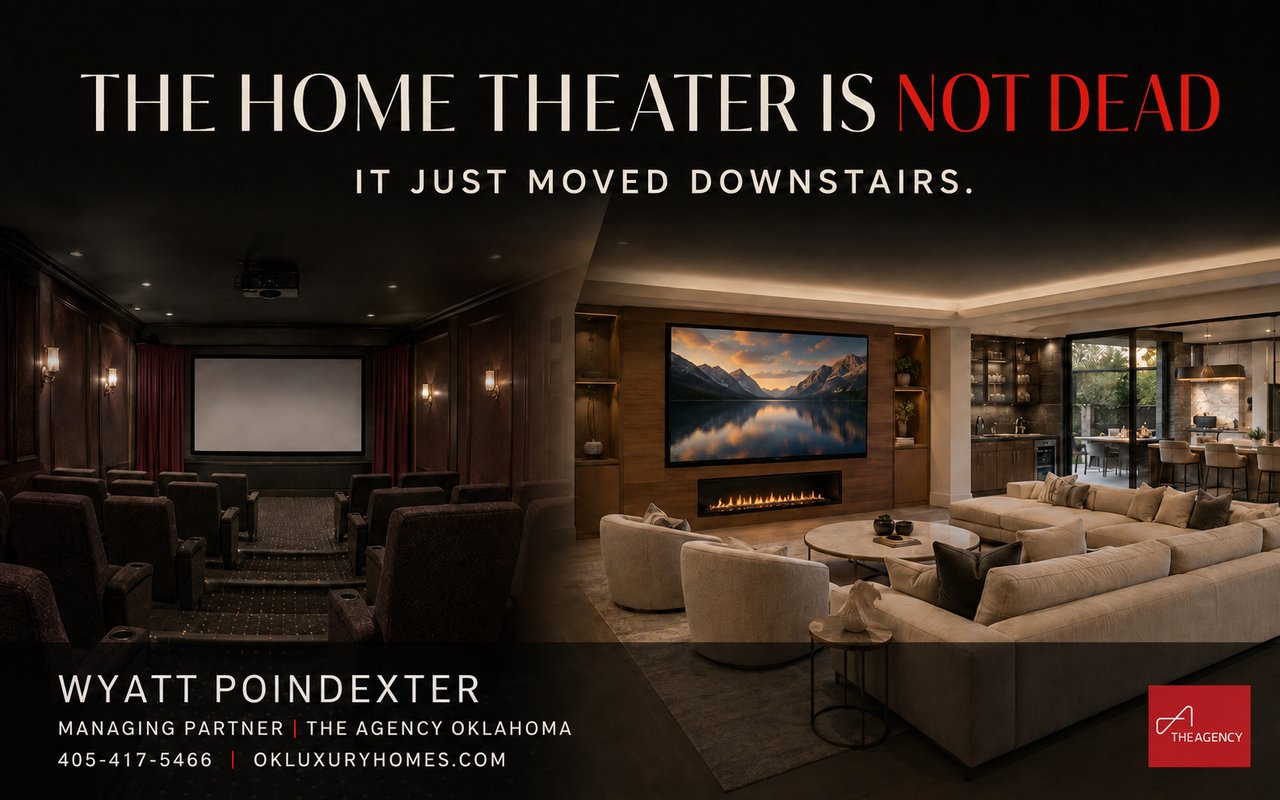
The Home Theater Is Not Dead. It Just Moved Downstairs.
For many years, the dedicated home theater was one of the most recognizable features of a luxury home. Builders regularly placed these rooms upstairs, often beside a game room or at the end of a hallway. They were designed to recreate the experience of going to the movies, complete with dark walls, tiered floors, rows of theater seating, surround sound, a ceiling-mounted projector and a large screen.
Every chair faced the same direction, and the room served one purpose: watching movies.
Twenty years ago, buyers walked into these spaces and immediately saw luxury. Today, many buyers walk in and begin thinking about how they could use the room differently.
After spending more than three decades touring and selling homes, I have watched this change happen firsthand. Buyers still want an incredible place to watch movies, television and sports. What they no longer necessarily want is a dark, isolated theater hidden upstairs and disconnected from the rest of the home.
The home theater is not disappearing. It is simply being redesigned around the way people actually live.
Why Traditional Theater Rooms Are Losing Their Appeal
The traditional theater room was designed around the screen rather than the people watching it.
That is one of the biggest reasons these spaces are becoming less desirable.
A dedicated theater sounds exciting when someone first purchases a home. The family may use it frequently for the first few months, but many eventually return to watching television in the main living room.
That is where life is happening.
The kitchen is nearby. Food and drinks are easy to reach. Parents can prepare dinner without being separated from everyone else. Friends can move naturally between the living room, kitchen, bar and outdoor entertaining areas. Nobody has to leave the gathering, climb the stairs and disappear into a specialized room to watch a game.
Over time, many upstairs theaters become some of the least-used spaces in the home. Some turn into storage rooms. Others become makeshift playrooms, gyms or guest rooms.
Unfortunately, the features that made them feel like theaters can also make them difficult to repurpose. Permanent tiered platforms limit furniture placement. Dark finishes may not work for another use. Limited windows and specialized wiring can make the room feel closed off. The expensive theater seating that once looked impressive may eventually feel dated and inflexible.
Modern buyers place a high value on rooms that can change with their lifestyles. A highly specialized theater does not always provide that flexibility.
Luxury Has Become More Comfortable
Luxury home design has become less formal and more focused on comfort, connection and everyday use.
This shift can be seen throughout the house. Formal living rooms are becoming offices or libraries. Traditional dining rooms are being replaced by larger kitchens and casual dining areas. Separate game rooms are evolving into multifunctional entertainment spaces.
The same thing is happening to the home theater.
Today’s luxury media room often feels more like a private lounge than a commercial cinema. Instead of several rigid rows of identical theater chairs, homeowners are choosing deep sectionals, oversized sofas, comfortable swivel chairs, ottomans and flexible seating arrangements.
Families want to stretch out. Children want to sit on the floor. Friends want to turn toward one another and have a conversation. Someone may want to watch the game while another person sits nearby with a laptop or a glass of wine.
The room must accommodate people, not just the screen.
A beautifully designed media lounge can still deliver a cinematic experience, but it can also host a football watch party, an evening with friends, a family game night or a quiet Sunday afternoon.
That versatility makes the room more likely to be used regularly.
The Entertainment Room Has Moved Closer to the Action
One of the most noticeable changes is location.
The old theater was commonly placed upstairs because it was easier to isolate from the main living spaces. Today, many buyers prefer the media room on the first level, positioned near the kitchen, living room, bar, pool or outdoor entertaining area.
That location allows the room to become part of the home’s natural flow.
During a party, guests can move between spaces without becoming separated from everyone else. During a Thunder game, someone can refill a drink or grab food without making a trip downstairs. Parents can remain connected to children while still enjoying other areas of the home.
In the right house, the entertainment room may open directly to the pool or covered patio. With large glass doors, the room can serve as an indoor and outdoor gathering space. The television can remain visible from multiple areas, and the room continues to feel connected even when people are moving around.
This is especially important in Oklahoma, where homes are frequently designed for entertaining during football season, basketball season and long evenings around the pool.
A first-floor media lounge simply fits that lifestyle better than a dark theater hidden upstairs.
Large Televisions Changed the Entire Conversation
Traditional home theaters became popular when a projector was the only practical way to create a truly large picture.
That is no longer the case.
Flat-screen televisions are now available in and around the 100-inch range, with some models extending well beyond it. These televisions can produce an exceptionally bright, sharp image without requiring a dark room, a ceiling-mounted projector or a separate screen.
Projectors still have a place. In a properly designed theater with excellent lighting control and acoustics, a quality projection system can create an immersive experience that feels very close to a commercial cinema.
However, a projector also introduces additional considerations. The room may need to remain dark. The equipment must be positioned correctly. The image can be affected by natural light, and the system may require more specialized installation and maintenance.
A large television is generally simpler. It turns on instantly, performs well during the day and allows the room’s lights to remain on. The space does not have to feel like a cave every time someone wants to watch something.
That flexibility has changed the design of entertainment rooms.
Homeowners can now incorporate windows, lighter colors, artwork and more sophisticated architectural details without compromising the viewing experience. The television can be installed within custom cabinetry, positioned on a feature wall or surrounded by shelving that helps it feel integrated into the room.
When the television is turned off, the space can still feel warm, attractive and connected to the rest of the home.
Technology Is Becoming Less Visible
Older theater rooms often made the equipment part of the design. Speakers were mounted on walls, projectors hung from ceilings, components were stacked inside cabinets and multiple remote controls were required to operate everything.
Today’s buyers generally want the performance without seeing all the equipment.
Speakers can be concealed inside walls and ceilings. Subwoofers can be integrated into cabinetry. Wiring can be hidden. Lighting, sound, shades and television controls can be managed through one system.
The best modern media rooms do not necessarily look technical. They simply work.
That distinction matters in luxury homes. Buyers want sophisticated technology, but they also want clean architecture and attractive interiors. The equipment should support the experience without dominating the room.
What Today’s Buyers Want
The modern buyer still wants a large screen, excellent sound and a memorable place to watch movies and sports. The difference is that the room must offer more than that.
Buyers increasingly want a space that is comfortable enough to use every day, close to the home’s primary gathering areas and flexible enough to support several activities. They want attractive finishes, natural light when appropriate and seating that encourages both conversation and relaxation.
Many also want convenient access to a bar, beverage refrigerator, snack area or outdoor kitchen. They want the ability to watch a game while entertaining without forcing every guest to sit silently in rows.
Most importantly, they want the room to feel relevant even when the television is turned off.
Should Homeowners Remove an Existing Theater?
Not necessarily.
A true home theater can still be an exceptional luxury feature, particularly in a large estate with enough square footage to support several specialized rooms. A professionally designed theater with outstanding acoustics, sound isolation, comfortable seating and current technology can still be an unforgettable part of a home.
The issue is not the existence of a theater. The issue is whether the room is good enough and useful enough to justify the space it occupies.
An extraordinary theater can add to the experience of a luxury estate. A small upstairs room with aging equipment, worn theater chairs and a dated projector may not carry the same appeal.
Homeowners preparing to sell should consider whether the room still presents well to today’s buyers. In some cases, replacing the chairs with a comfortable sectional, updating the display and creating a more flexible arrangement can completely change how buyers respond to the space.
The goal should be to preserve the entertainment experience while making the room feel more comfortable, current and useful.
The Next Generation of Luxury Entertainment
The traditional theater room was designed to imitate a night at the movies. The modern media lounge is designed to bring people together.
It is more comfortable, more flexible and more connected to the rest of the home. It can still deliver an incredible cinematic experience, but it does not have to remain empty until someone decides to watch a two-hour movie.
The most successful luxury spaces are not simply impressive when photographed. They are spaces people genuinely want to use.
That is the real change I am seeing in Oklahoma luxury homes. Buyers still want the large screen, excellent sound and unforgettable entertainment experience.
They just want it in a room where everyone naturally gathers.
Wyatt Poindexter
Managing Partner, The Agency Oklahoma City & Tulsa
Oklahoma Luxury Real Estate
405-417-5466
[email protected]
www.OKLuxuryHomes.com